



 Why 3D

From molecular detail to whole structures,
we need a truly 3D perspective.
Life itself is 3D, but traditional research methods have largely confined our view.
To truly understand tissue architecture, molecular expression, and disease mechanisms, we must return to life in its original form, through the 3D lens of spatial multi-omics.
To truly understand tissue architecture, molecular expression, and disease mechanisms, we must return to life in its original form, through the 3D lens of spatial multi-omics.
Why do we need a 3D perspective?
Biological Tissues Exist in 3D.
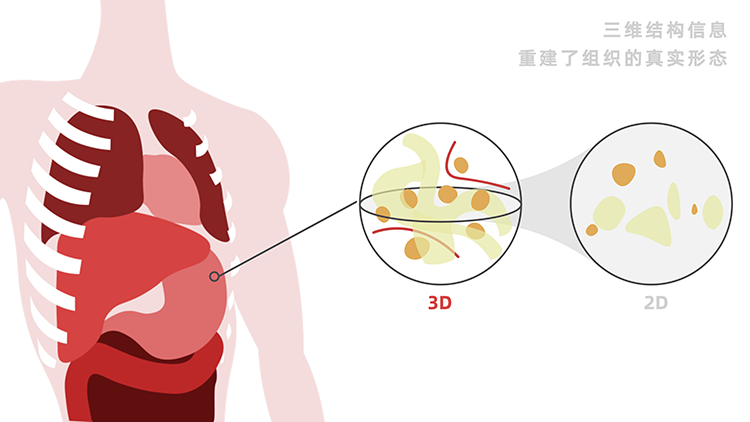
Cell morphology, organ architecture, and lesion infiltration all exist as continuous 3D structures. However, two-dimensional sectioning often disrupts structural continuity, overlooking fine channels and failing to capture branching or encapsulated forms. Without 3D dimension, the shape and orientation of tissues cannot be accurately assessed.
3D imaging can preserve tissues in their original form, providing the foundation for accurate reconstruction and spatial analysis.
3D imaging can preserve tissues in their original form, providing the foundation for accurate reconstruction and spatial analysis.
3D Spatial Distribution Shapes Molecular Expression.
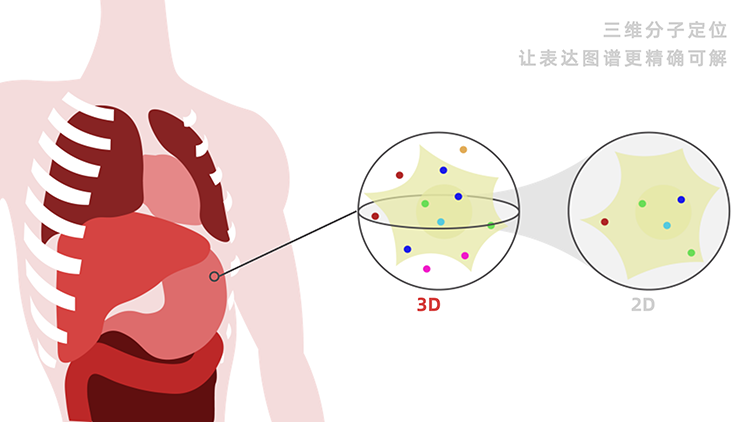
The expression of molecular markers such as proteins and nucleic acids depends on their 3D location within tissues. Two-dimensional sectioning cannot capture signals beyond the cut surface, leading to information loss or misalignment. Without 3D context, it is also difficult to accurately restore the intensity and distribution of molecular expression.
3D imaging can provide precise spatial quantification of molecules, allowing for more accurate mapping of expression and mechanistic.
3D imaging can provide precise spatial quantification of molecules, allowing for more accurate mapping of expression and mechanistic.
3D Data Greatly Expands Information Content.
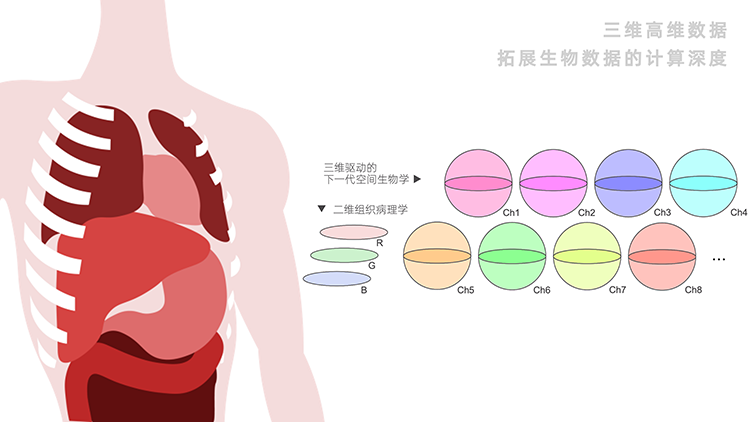
Compared with 2D images from traditional sectioning, 3D imaging increases the information obtained from each sample by hundreds to tens of thousands of times. It not only enhances data density but also reveals more detailed connections between tissue structure and molecular expression.
With fewer samples, higher information density, and deeper structural insights, such 3D datasets can support the training of AI models and, in turn, contribute to more precise medical decision-making.
With fewer samples, higher information density, and deeper structural insights, such 3D datasets can support the training of AI models and, in turn, contribute to more precise medical decision-making.
TP MedTech’s 3D spatial multi-omics platform
was created to meet this need.
As the world’s first 3D-AI spatial biology platform, we deliver large-scale, high-preservation, and multi-modal 3D spatial data, and use AI models to enable smarter interpretation and decision-making.From research to clinic, 3D spatial multi-omics is reshaping how we understand life itself.